112 Founders Drive Baton Rouge, LA 70810 | 225-756-0222
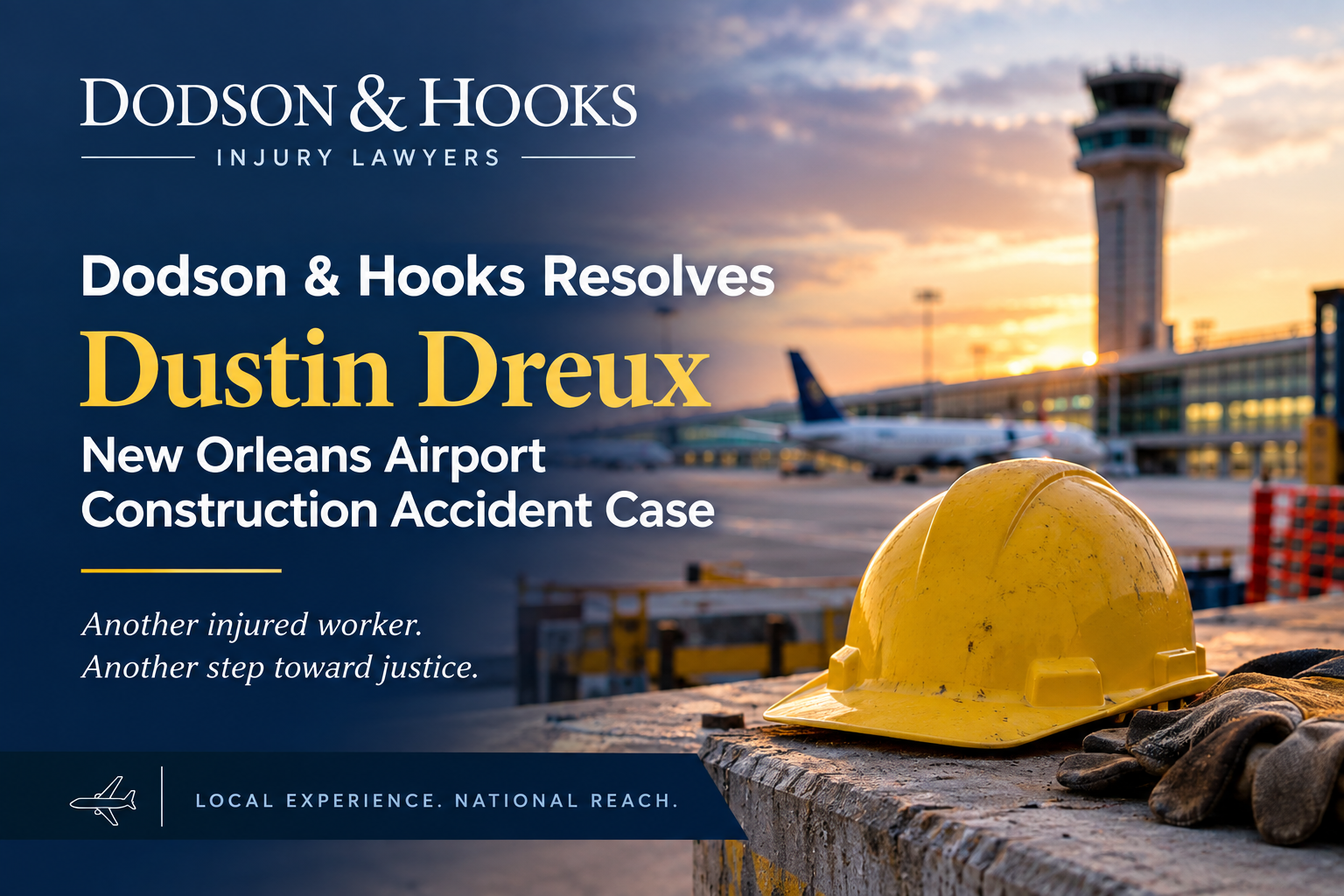
Dodson & Hooks Resolves Dustin Dreux New Orleans Airport Construction Accident Case

Dodson & Hooks represented Dustin Dreux in a serious construction and premises-liability case arising from the unexpected activation of an airport baggage conveyor system at the new terminal serving Louis Armstrong New Orleans International Airport. Mr. Dreux alleged that the moving conveyor threw him backward to the floor while he was performing firestopping work in a restricted baggage-handling area.
The August 2020 incident led to severe right-shoulder injuries, extensive treatment, two shoulder surgeries, prolonged physical therapy, continuing functional problems, and psychological injuries associated with chronic pain and the loss of his ability to work. The litigation required a detailed examination of responsibility among the general contractor, baggage-system interests, security and
maintenance personnel, subcontractors, and other entities working in a complex, controlled construction environment.
The parties ultimately reached a confidential resolution. The exact amount, allocation, negotiations, and other settlement terms cannot be disclosed. The resolution was a compromise of disputed claims, and the settling parties expressly denied liability and wrongdoing.
The Airport Baggage Conveyor Accident
On the night of August 16, 2020, Mr. Dreux was working at the newly constructed airport terminal in New Orleans. He was employed by J-Kaulk Fire Stopping, Inc., a subcontractor performing firestopping work intended to help protect the building from the spread of fire and smoke through wall penetrations and other openings.
The work required access to a wall in the restricted baggage-handling area. According to Mr. Dreux’s allegations, he and a coworker were escorted into the secure area for the assigned nighttime work. To reach the work location, Mr. Dreux had to position himself above or upon part of the baggage conveyor system. Protective plastic sheeting had been placed over the conveyor to prevent damage while the firestopping material was applied.
The lawsuit alleged that the conveyor unexpectedly activated and began moving while Mr. Dreux was working. The sudden movement caused him to fall backward from the conveyor area and land forcefully on the right side of his body. The parties disputed fault, causation, responsibility, and the extent of the claimed injuries.
Why Conveyor Systems Require Strict Energy Control
Airport baggage-handling systems are not ordinary belts. They are interconnected mechanical and computerized systems that can include conveyors, sensors, programmable controls, automatic start sequences, remote control rooms, emergency stops, maintenance modes, and multiple operating zones. A section that appears stationary can start automatically when a sensor or system command is triggered.
When construction, inspection, maintenance, or other work places a person on or near conveyor machinery, preventing unexpected energization is essential. Depending on the equipment and the task, safety measures may include shutdown procedures, isolation of the affected zone, lockout and tagout, verification of a zero-energy state, control-room notification, barricades, spotters, permits, and direct coordination among every contractor with access to the system.
A warning that equipment might move is not a substitute for an effective energy-control plan. The responsible entities must know who is working in the area, which conveyor sections could activate, who has authority to energize them, and how the system will be physically or electronically isolated until the work is complete.
Multiple Companies and Overlapping Responsibilities
Large public construction projects often involve an owner, program managers, a general contractor, joint-venture partners, specialty subcontractors, equipment manufacturers, system integrators, maintenance contractors, security providers, and consultants. Each entity may control a different part of the site or possess different information about the work.
The Dreux litigation was filed in the Civil District Court for the Parish of Orleans as Dustin Dreux v. Hunt Gibbs Boh Metro, a Joint Venture, et al., Case No. 2021-02524, Section C-10. The suit involved entities associated with construction of the new airport terminal, operation or control of the baggage-handling system, and access to the restricted work area. The claims required investigation into who controlled the conveyor, who knew that firestopping work would occur, who granted access, and who was responsible for ensuring that the machinery remained safely de-energized.
A worker injured on a construction project may receive workers’ compensation benefits from his direct employer while also having a separate tort claim against a negligent third party. Identifying third-party defendants can be critical because workers’ compensation ordinarily does not provide the full range of damages available in a civil personal-injury action.
The Communication and Coordination Questions
One of the central factual issues was how Mr. Dreux could be allowed into a secure baggage-handling area to perform assigned work while the conveyor remained capable of activation. The investigation examined access control, shift changes, control-room responsibilities, work authorization, daily task reports, security practices, system monitoring, and communication among different contractors and departments.
The case highlighted a recurring danger on major projects: one company may assign the work, another may control the room, another may operate the equipment, and still another may be responsible for safety coordination. Unless those responsibilities are clearly defined and actively communicated, each group may assume that someone else has made the area safe.
After an accident involving energized equipment, counsel should promptly seek electronic control logs, access records, surveillance video, work orders, timesheets, daily reports, safety meetings, permits, emails, text messages, incident reports, and written procedures. Those materials can establish who was present, when a system command occurred, which safeguards were required, and whether the work had been properly communicated.
A Severe Right Shoulder Injury
Mr. Dreux sought medical care immediately after the incident for pain involving his right shoulder, hip, knee, and ankle. The right shoulder became the most significant orthopedic injury. An MRI documented full-thickness tearing involving the rotator cuff as well as additional shoulder pathology. His physicians recommended operative repair after conservative treatment failed to restore function.
In March 2021, Mr. Dreux underwent right-shoulder arthroscopy that included subacromial decompression, distal-clavicle excision, rotator-cuff repair with allograft patch augmentation, and labral treatment. He then completed extensive postoperative therapy and rehabilitation. Despite that work, he continued to experience pain, weakness, catching, popping, restricted motion, and impaired use of the arm.
Follow-up imaging and examinations raised concern that the rotator-cuff repair had not healed adequately or had torn again. In September 2022, Mr. Dreux underwent a second right-shoulder arthroscopy. The revision procedure included additional decompression, debridement, removal of prior suture material, repeat rotator-cuff repair, and another allograft patch augmentation.
Revision shoulder surgery is a major event. Recovery may require months of immobilization, therapy, gradual strengthening, activity limitations, and medical follow-up. Even with appropriate care, a worker may be left with pain, weakness, reduced endurance, and restrictions that interfere with overhead work, lifting, climbing, reaching, and other construction duties.
Psychological Injuries After a Workplace Fall
A catastrophic workplace injury can affect far more than the injured body part. Chronic pain, failed surgery, financial uncertainty, unemployment, sleep disruption, and the sudden loss of an occupational identity can produce profound psychological consequences.
Mr. Dreux’s treatment included psychiatric care for conditions attributed to the accident and its aftermath. His records described depression, post-traumatic stress symptoms, panic, nightmares, flashbacks, dissociative or “zoning out” episodes, anger, guilt, anxiety, and frustration related to chronic pain and inability to return to work. His doctors considered both physical and psychological limitations when assessing his capacity to resume employment.
Psychological injuries are real injuries. In a serious personal-injury case, they should be evaluated through qualified treatment rather than minimized as an ordinary reaction to litigation. A complete damages analysis considers the person’s function, relationships, sleep, concentration, confidence, independence, and quality of life alongside the orthopedic diagnosis.
Loss of Earning Capacity and the Desire to Work
Construction and firestopping work require dependable use of the shoulders and arms. Workers may need to lift materials, carry tools, climb, balance, reach overhead, work from ladders or elevated positions, and maintain awkward postures. A significant dominant-arm or upper-extremity injury can prevent a skilled worker from returning to the same trade even when he wants to work.
The Dreux case examined past wage loss, future earning capacity, medical restrictions, physical function, vocational options, and the interaction between chronic pain and psychological symptoms. The proper measure is not simply whether a person can perform any task for a few minutes. It is whether he can obtain and sustain reliable employment in the real labor market given his education, experience, transferable skills, restrictions, symptoms, and need for ongoing care.
Mr. Dreux repeatedly expressed a desire to return to work. His claimed inability to do so was evaluated through the medical, psychiatric, vocational, and economic evidence developed during the case.
Workers Compensation and Third Party Claims
Mr. Dreux’s direct employer’s workers’ compensation insurer paid benefits associated with the accident and asserted a statutory lien in the third-party litigation. Louisiana law can permit an employer or compensation carrier to recover certain benefits from a responsible third party. The injured worker’s lawyer must account for that lien when evaluating settlement and determining the client’s net recovery.
A construction worker should not assume that receiving workers’ compensation prevents every lawsuit. Potential third-party claims may exist against a general contractor, property owner, equipment owner, system operator, maintenance company, another subcontractor, product manufacturer, or other entity whose conduct contributed to the incident. The available claims depend on the contracts, actual control, statutory-employer issues, insurance, and evidence.
Coordinating the compensation claim and the third-party case can be complicated. Medical authorization, benefit payments, future treatment, lien reduction, intervention rights, settlement approval, and the effect of one resolution on the other all require careful attention.
Building the Dustin Dreux Case
The Dreux matter required sustained investigation over several years. The legal team reviewed project documents, change orders, contractor relationships, access information, safety materials, discovery responses, testimony, medical records, imaging, operative reports, rehabilitation records, and workers’ compensation information. Depositions and witness investigation addressed the work assignment, conveyor operation, security, system control, and communication among the companies at the airport.
The case also required a detailed medical presentation. Two major shoulder operations, extensive physical therapy, persistent symptoms, psychiatric treatment, wage loss, and claimed inability to work had to be organized into a clear account of how one nighttime incident changed Mr. Dreux’s life.
Serious cases are rarely resolved by sending a few medical bills to an insurance adjuster. They require proof of legal responsibility, medical causation, the reasonableness and necessity of treatment, functional limitations, past economic loss, future loss, and the human consequences of the injury.
A Confidential Resolution
The parties ultimately resolved the Dreux litigation through a confidential settlement. The resolution brought the disputed claims to an end without a trial. The settling parties denied liability, fault, wrongdoing, and the factual and legal allegations asserted against them.
Because confidentiality and non-disparagement are material terms of the agreement, neither Dodson & Hooks nor Mr. Dreux can disclose or characterize the amount, allocation, negotiations, or other protected terms. This article therefore identifies only that the case was resolved confidentially and relies on neutral descriptions of the public allegations and general legal principles.
A confidential settlement is not a judicial finding and does not establish that any defendant acted negligently. It can nevertheless give an injured client certainty and finality while avoiding the expense, delay, and uncertainty of trial and appeal. Every settlement decision is personal and depends on the evidence, defenses, insurance, liens, medical needs, litigation risks, and the client’s goals.
What to Do After an Accident Involving Moving Equipment
A worker injured by a conveyor, lift, crane, vehicle, press, hoist, or other unexpectedly energized equipment should obtain emergency medical care and report the accident promptly. When possible, the worker or family should preserve the names of witnesses and photographs of the area without interfering with safety operations.
An early legal investigation should seek to preserve:
- surveillance footage and photographs of the accident area;
- control-system logs, alarms, sensor data, and activation records;
- access-control logs, badges, escorts, and security reports;
- work orders, permits, job-hazard analyses, and lockout records;
- contracts identifying control among owners, contractors, and subcontractors;
- daily reports, timesheets, shift assignments, emails, and text messages;
- the equipment’s manuals, design information, inspection records, and maintenance history;
- workers’ compensation records and asserted liens; and
- complete medical, surgical, rehabilitation, psychiatric, vocational, and wage evidence.
Electronic evidence may be overwritten, and construction conditions can change quickly. Consulting an experienced construction-accident lawyer early can help preserve information before equipment is modified, contractors leave the project, or witnesses become difficult to locate.
Dodson and Hooks Handles Serious Construction and Equipment Injury Cases
Dodson & Hooks is a Baton Rouge personal-injury and maritime law firm representing people with catastrophic injuries throughout Louisiana and beyond. The firm handles construction accidents, industrial-equipment injuries, conveyor and machinery incidents, offshore accidents, falls, fires, explosions, defective-product claims, severe orthopedic injuries, brain injuries, psychological trauma, permanent disability, and wrongful death.
Kenneth H. Hooks, III and the lawyers at Dodson & Hooks use a team approach and work with engineers, safety professionals, physicians, vocational experts, economists, investigators, and other specialists when a case requires their knowledge. The firm examines every potentially responsible party and available source of insurance while helping the client understand the relationship between workers’ compensation and third-party claims.
The Dustin Dreux matter demonstrates the firm’s willingness to pursue a fact-intensive case involving multiple contractors, controlled airport facilities, complex baggage-handling machinery, two shoulder surgeries, psychological treatment, and disputed responsibility. Prior results do not guarantee a similar outcome.
Contact a Louisiana Construction Accident Lawyer
If you or a family member was injured by a conveyor system, unexpectedly energized machinery, unsafe construction equipment, or inadequate coordination among contractors, contact Dodson & Hooks for a confidential consultation. The firm can investigate the project, preserve electronic and physical evidence, identify responsible companies, evaluate workers’ compensation liens, and determine whether a third-party lawsuit is available.
Call Dodson & Hooks at 225-756-0222 or toll free at 855-515-1257. The firm is located at 112 Founders Drive, Baton Rouge, Louisiana 70810. You may also request a consultation through DodsonHooks.com.
Attorney advertising. Prior results do not guarantee a similar outcome. Every case depends on its own facts, evidence, injuries, applicable law, defendants, insurance, and forum. The Dreux case was resolved through a confidential compromise without an admission of liability or wrongdoing.