112 Founders Drive Baton Rouge, LA 70810 | 225-756-0222
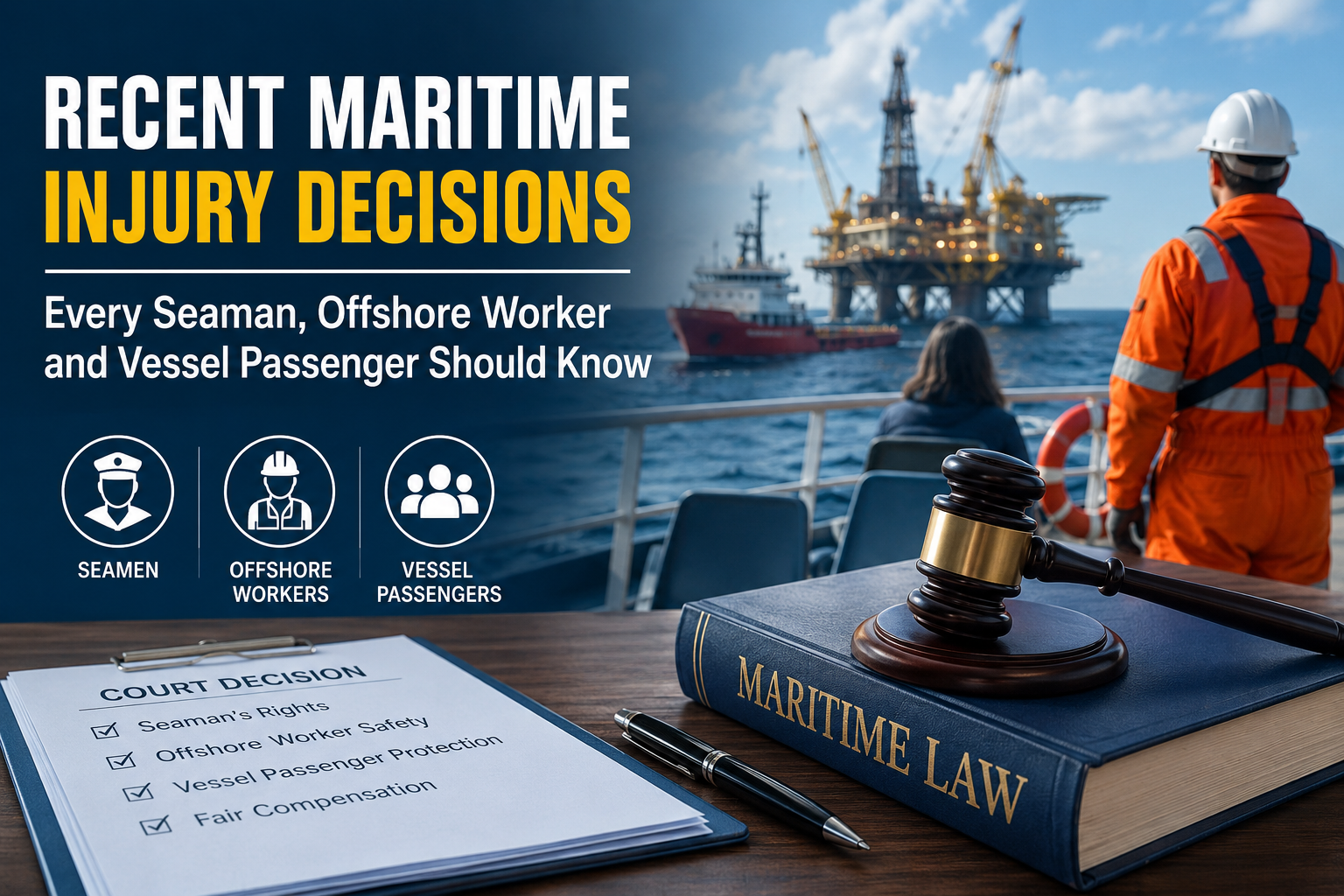
Recent Maritime Injury Decisions Every Seaman, Offshore Worker and Vessel Passenger Should Know

Maritime injury law continues to change in ways that can have significant consequences for injured seamen, offshore workers, longshore workers, vessel passengers, and their families.
Recent federal court decisions illustrate an important point: where an accident happens is only the beginning of the maritime-law analysis.
The worker’s status, the type and use of the vessel, the identity of the defendant, the language of an employment agreement, and even the statute under which a lawsuit is filed can determine whether an injured person is entitled to pursue a claim—and sometimes where that claim must be pursued.
Several recent 2026 maritime decisions are particularly important.
1. A Major Fifth Circuit Decision Limits the Ability of Some Small-Vessel Owners to Limit Their Liability
One of the most significant recent maritime personal injury decisions for Gulf Coast workers is In re M/V MS ADALYN, No. 25-20584, 2026 U.S. App. LEXIS 24660 (5th Cir. Aug. 14, 2026).
The case involved the ADALYN, a 38-foot commercial workboat weighing less than 100 gross tons. The vessel was being used in connection with dredging operations on the Alabama River.
Eight employees of the dredging contractor were being transported aboard the vessel when it ran aground and struck a stationary steel pipe, allegedly injuring the workers.
The vessel interests responded in a familiar way: they filed a federal limitation action seeking protection under the federal Limitation of Liability Act.
For generations, vessel owners have used the Limitation Act in an attempt to restrict their financial exposure following serious maritime casualties.
But Congress changed the law following the tragic CONCEPTION passenger-vessel fire.
The amended statute excludes certain “covered small passenger vessels” from the protection traditionally afforded by the Limitation Act.
The question in ADALYN was whether this commercial workboat fell within that exclusion.
Were Workers Really “Passengers for Hire”?
That became one of the critical questions.
The workers themselves had not personally purchased tickets to ride aboard the ADALYN. Instead, their employer paid a flat daily rate for use of the vessel.
The vessel interests argued that this did not make the employees “passengers for hire.”
The Fifth Circuit disagreed.
The court concluded that Congress did not require the passenger personally to hand money to the vessel owner. Because the workers’ employer paid for use of the vessel and that use included transporting the employees, the employees qualified as passengers for hire.
The Fifth Circuit therefore held that the ADALYN was a covered small passenger vessel excluded from the Limitation Act.
That distinction mattered enormously: the vessel interests could not use the Limitation Act to attempt to cap their liability for the workers’ injuries.
Why ADALYN Matters to Gulf Coast Maritime Workers
The decision is especially important in Louisiana, Texas, Alabama, Mississippi, and other areas where small commercial vessels routinely transport workers to dredges, platforms, vessels, construction projects, and other marine worksites.
A vessel does not necessarily have to look like a traditional passenger vessel for the new limitation rules to apply.
And a worker does not necessarily have to purchase an individual ticket to qualify as a passenger for hire.
The financial arrangement between the vessel owner and the worker’s employer may be enough.
For an injured worker, that issue can potentially mean the difference between confronting a severely restricted limitation fund and pursuing the full damages otherwise available under applicable law.
2. A Seaman May Be Required to Arbitrate a Jones Act Injury Claim
Another important 2026 decision demonstrates why maritime workers should pay careful attention to the documents they sign when accepting employment.
In Tucker v. Centerline Logistics Corp., No. 1:25-cv-2004, 2026 U.S. Dist. LEXIS 95590 (E.D.N.Y. Apr. 29, 2026), a seaman was injured during a line-heaving operation involving a barge and tug in Puerto Rico.
He sued under the Jones Act and general maritime law, asserting claims that included negligence, unseaworthiness, and maintenance and cure.
His employer moved to compel arbitration based upon an agreement the seaman had signed when he was hired.
The seaman argued, among other things, that the Federal Arbitration Act excludes seamen’s employment contracts and that the Jones Act provides a right to a jury trial.
The court nevertheless enforced the arbitration agreement.
The judge reasoned that the FAA’s exclusion of seamen’s employment contracts meant that the FAA’s enforcement mechanisms were unavailable; it did not automatically make the arbitration agreement itself unenforceable. The court also rejected the argument that the Jones Act right to a jury trial necessarily prevented arbitration.
There was another important provision in the agreement.
It stated that controversies concerning whether an issue could be arbitrated would themselves be decided by the arbitrator. The court therefore concluded that whether the agreement encompassed the Jones Act claims was an issue for the arbitrator.
Why This Matters to Injured Seamen
A maritime employment agreement may contain far more than wage and work provisions.
It may contain:
- an arbitration clause;
- a delegation provision giving the arbitrator authority to decide arbitrability;
- a foreign choice-of-law provision;
- a forum-selection clause; or
- other provisions affecting how and where an injury claim can be pursued.
This can be particularly important for foreign seafarers working aboard internationally operated vessels.
An injured seaman should therefore have the actual employment agreement, collective bargaining agreement, arbitration agreement, and related hiring documents reviewed as early as possible.
The existence of an arbitration provision does not necessarily mean that every claim must be arbitrated. But Tucker demonstrates why it is dangerous to assume that a Jones Act claim automatically guarantees access to a jury.
3. A Longshore Worker’s Case Shows How Important Maritime Safety Experts Can Be
In Lowery v. Avenue 8 Holding Ltd., No. 3:24-cv-3107, 2026 U.S. Dist. LEXIS 109955 (N.D. Cal. May 18, 2026), a longshore worker employed by SSA Terminals was assisting with cargo operations aboard the MSC GIULIA at the Port of Oakland.
He alleged that he was climbing a ship’s ladder through a hatch when an unsecured handhold railing folded backward onto him and caused him to fall.
The litigation involved challenges to maritime safety experts offered by both sides.
The court permitted substantial portions of the expert testimony.
One captain was allowed to testify based upon her maritime experience and knowledge of industry standards even though she had not personally inspected the vessel or taken measurements. Her opinions could be based upon her experience, industry standards, and documentary evidence concerning the accident.
A longshore expert with extensive practical experience—including approximately 20 years as a walking boss—was likewise permitted to testify about longshore practices and customs, although the court restricted him from offering opinions outside his expertise concerning the alleged physical defect itself.
The Lesson for Longshore Injury Cases
Longshore cases frequently involve more than proving that an accident occurred.
A claim against vessel interests can require a detailed examination of:
- the condition of the vessel when cargo operations began;
- vessel equipment;
- ladders, hatches and handrails;
- industry customs and practices;
- what the vessel crew knew;
- what the stevedore knew;
- inspection and maintenance records;
- photographs and video;
- vessel logs; and
- the respective responsibilities of the vessel and stevedore.
The Lowery decision demonstrates the potential importance of retaining experts with the correct maritime experience and carefully defining the subjects on which they will testify.
4. An Offshore Platform Injury Shows Why “Who Controlled the Work?” Can Be Critical
Not every offshore accident results in liability against the platform owner.
That principle is illustrated by Hogan v. BP Corp. North America Inc., No. 2:25-cv-425, 2026 U.S. Dist. LEXIS 91791 (E.D. La. Apr. 27, 2026).
The worker was employed by an independent contractor as a blaster/painter on the Thunder Horse Platform offshore Louisiana. He alleged that he tripped over a rope on a stairway and sued BP.
The court applied Louisiana law to the accident on the fixed Outer Continental Shelf platform.
The contract provided that the worker’s employer was responsible for managing and supervising its work. The worker presented no evidence that BP actually controlled his work or assumed a separate safety duty. The court consequently granted summary judgment for BP.
Why Offshore Injury Cases Require an Immediate Status Analysis
People commonly use the phrase “offshore injury” as though it describes a single category of case.
It does not.
Depending upon the facts, an offshore worker may potentially be governed by the:
Jones Act, general maritime law, Longshore and Harbor Workers’ Compensation Act, Outer Continental Shelf Lands Act, state law, or a combination of federal and state principles.
Whether the structure involved is a vessel or fixed platform can be critical.
So can the worker’s relationship to the vessel, the nature of the worker’s duties, and the degree of control exercised by the various companies at the worksite.
That is why determining seaman status and the applicable body of law should be among the first steps in investigating a serious offshore accident.
5. Filing Under the Wrong Federal Statute Can Destroy a Maritime Injury Claim
A particularly harsh example comes from Lantigua-Núñez v. United States Coast Guard, No. 24-2067, 2026 U.S. App. LEXIS 12687 (1st Cir. May 1, 2026).
The plaintiff was operating a “go-fast vessel” in international waters near Puerto Rico. Coast Guard vessels and a helicopter attempted to stop the boat. After warning shots were fired, shots were directed at the engine to disable the vessel, and two rounds struck the helmsman.
He pursued an administrative claim under the Federal Tort Claims Act (FTCA) and later filed suit.
The problem was that the federal courts concluded that his claim sounded in admiralty and belonged under the Suits in Admiralty Act (SIAA) rather than the FTCA.
By the time that problem was addressed, a claim under the SIAA was time-barred.
The First Circuit affirmed dismissal with prejudice.
The Broader Lesson: Maritime Deadlines Can Be Unforgiving
This decision illustrates one of the most dangerous misconceptions surrounding maritime claims:
There is not one universal statute of limitations for every accident involving a boat or ship.
The deadline can depend upon the claim, defendant, location, contractual documents, and governing statute.
Claims against the United States present additional complications.
Cruise passenger contracts may impose their own notice and filing requirements.
Cargo cases can have different deadlines.
And limitation proceedings can establish court-ordered deadlines for filing claims.
A seriously injured person should therefore avoid assuming that the ordinary state-law personal injury deadline applies merely because the accident happened near a particular state.
6. Even Missing a Limitation-of-Liability Deadline Does Not Always End the Claim—but It Is Dangerous
Federal limitation proceedings create another procedural problem for injured people.
After a vessel owner files a Limitation of Liability action, the federal court generally establishes a deadline by which claims must be filed.
In In re Colangelo, involving a collision between two vessels in New York’s East River, several injured passengers learned about the limitation proceeding only after the claims deadline had passed.
Their lawyer demonstrated efforts to identify the vessel owner, including contacting police, emergency medical services and the Coast Guard and hiring an investigator.
After discovering the limitation proceeding, counsel acted promptly.
The court permitted the late claims, emphasizing the claimants’ diligence, the early procedural stage of the litigation, and the absence of prejudice.
But injured maritime claimants should not rely upon receiving that type of relief.
A limitation proceeding can establish a deadline that requires action considerably sooner than a claimant might otherwise expect.
7. Recent Houston Ship Channel Litigation Highlights Limits on Maritime Wrongful-Death Damages
The consequences of a maritime accident can also depend heavily upon who is bringing the claim and against whom it is asserted.
Recent litigation arising from a collision in the Houston Ship Channel demonstrates the complexity.
In In re Houston Fleeting Services LLC, the M/V YANGZE 7 collided with the M/V MISS PEGGY, which capsized and sank.
A seaman aboard the MISS PEGGY died, and other crewmembers were injured. Claims were asserted under the Jones Act and general maritime law.
The court dismissed the deceased seaman’s estate’s claim for future lost earnings/loss of support, explaining that loss-of-support recovery belonged to dependents rather than the estate itself. The court also dismissed claims for punitive damages under the Jones Act and general maritime-law unseaworthiness theories.
The litigation also addressed whether injured seamen could recover non-pecuniary damages against the owner of the other vessel involved in the collision.
Maritime Wrongful-Death Damages Are Not the Same as Ordinary Wrongful-Death Damages
This distinction is important for families.
Following the death of a maritime worker, the recoverable damages may depend upon such questions as:
- Was the deceased a Jones Act seaman?
- Did the death occur in territorial waters or on the high seas?
- Was the defendant the seaman’s employer?
- Was another vessel responsible?
- Who qualifies as a statutory beneficiary?
- Is the claim being asserted by the estate, surviving spouse, children, parents, or other dependents?
- Does the Death on the High Seas Act apply?
- Are the claimed damages pecuniary or non-pecuniary?
Those questions should be analyzed before evaluating the potential value of a maritime wrongful-death case.
8. Cruise Ship Injury Cases Continue to Show How Important “Notice” Is
Passengers injured aboard cruise ships face another recurring maritime-law obstacle: proving that the cruise line had actual or constructive notice of the dangerous condition.
In McQueen v. MSC Cruises, S.A., a passenger alleged that she slipped in a wet or sticky area outside the spa aboard the MSC SEASHORE.
The passenger pointed to heavy traffic in the area, nearby food service, passengers carrying food and beverages, and crewmembers assigned to monitor and clean the vessel.
The court nevertheless concluded that the evidence did not establish that the particular dangerous condition had existed long enough for the cruise line to discover and correct it. Summary judgment was entered for the cruise line.
The lesson is important.
Simply proving that a passenger fell aboard a cruise ship is generally not enough to establish negligence.
Evidence concerning how the condition developed, how long it existed, prior similar accidents, inspection procedures, surveillance footage, maintenance records, work orders, photographs, and witness testimony may become critical.
Much of that evidence is controlled by the cruise line.
That makes early preservation and investigation particularly important.
What These 2026 Maritime Cases Tell Injured Workers and Their Families
Although these decisions involve very different accidents, several themes emerge.
First, maritime law is highly dependent upon classification. Whether someone is legally considered a seaman, longshore worker, passenger, offshore contractor, or passenger for hire can dramatically alter the applicable law.
Second, the identity of the defendant matters. A claim against an employer may be governed differently from a claim against another vessel owner, platform owner, cruise line, or the United States.
Third, contracts matter. Arbitration clauses and other employment provisions can affect where a seaman’s injury claim is decided.
Fourth, deadlines matter. Choosing the wrong statute or failing to identify a limitation proceeding can jeopardize an otherwise legitimate claim.
Finally, evidence matters early. Vessel records, employment contracts, surveillance video, electronic communications, safety documents, inspection records, photographs, witness statements and vessel data may become important long before a maritime case reaches trial.
Injured at Sea or While Working Offshore?
Maritime law is a specialized area of federal law. The legal rights of an injured seaman, longshore worker, offshore worker, or vessel passenger may be very different from those of someone injured on land.
Dodson & Hooks represents individuals and families in serious maritime and personal injury matters. Our maritime practice includes cases involving vessel accidents, injured seamen, offshore casualties, Jones Act claims, unseaworthiness, maintenance and cure, longshore and harbor worker injuries, vessel negligence, and maritime wrongful death.
When a serious maritime accident occurs, one of the most important steps is determining which law applies, who may be responsible, where the claim can be brought, and what evidence needs to be preserved.
Because maritime claims can involve specialized statutes, contractual provisions, and unusually short deadlines, those questions should be addressed as early as possible.