112 Founders Drive Baton Rouge, LA 70810 | 225-756-0222
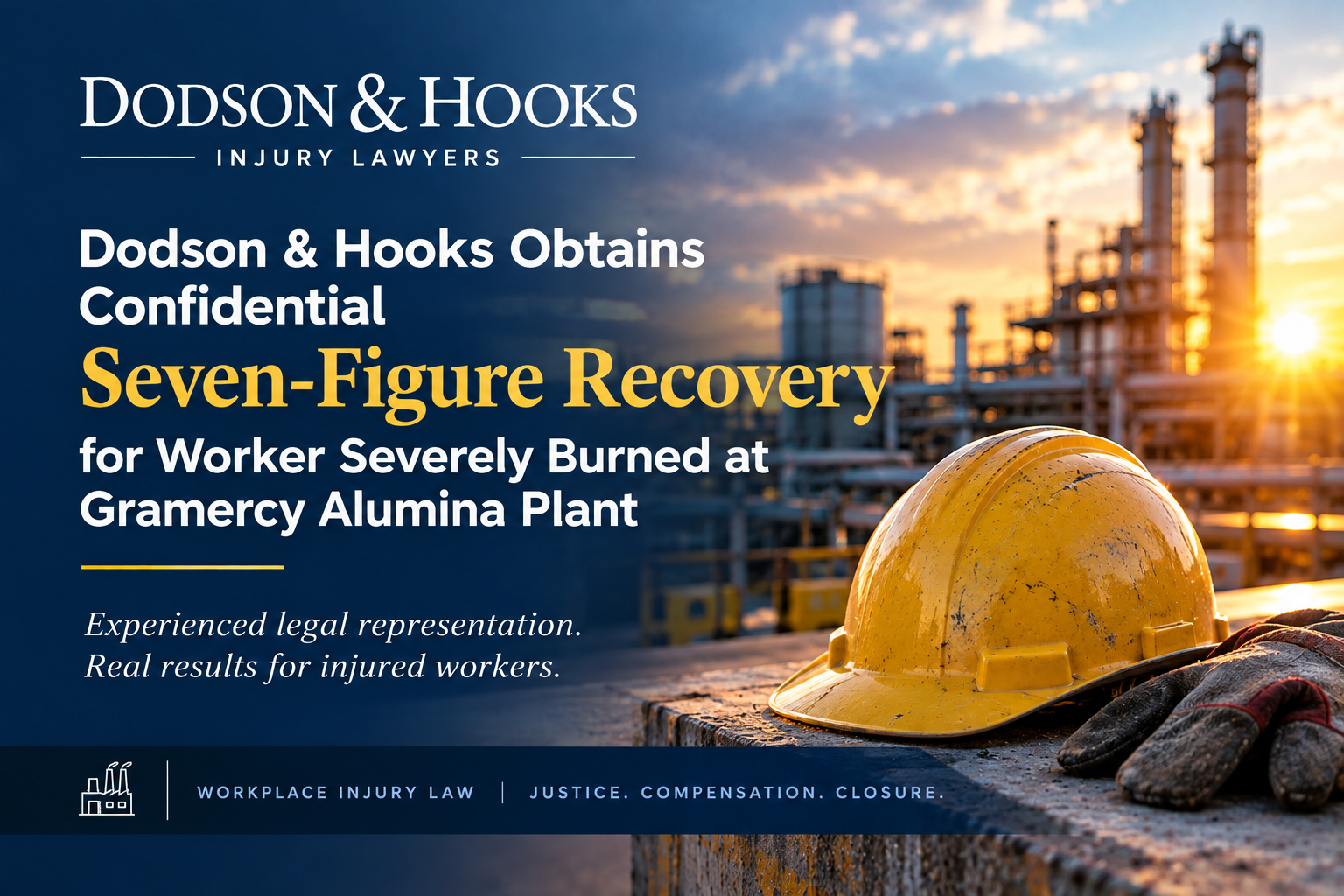
Dodson & Hooks Obtains Confidential Seven Figure Recovery for Burnell Joseph After Catastrophic Chemical Burns at Gramercy Alumina Plant

Dodson & Hooks Obtains Confidential Seven Figure Recovery for Burnell Joseph After Catastrophic Chemical Burns at Gramercy Alumina Plant
Dodson & Hooks obtained a confidential seven-figure recovery for Burnell Joseph in litigation arising from a catastrophic industrial chemical exposure at the ATALCO alumina facility in Gramercy, Louisiana. The case involved severe caustic burns, alleged permanent injuries and vision loss, a leaking valve on Precipitator Tank 41, federal mine-safety regulation, industrial process engineering, product-liability claims, and Louisiana’s narrow intentional-act exception to workers’ compensation immunity.
The resolution followed extensive factual discovery, corporate testimony, expert analysis, and contested federal-court motion practice. The settlement was a compromise of disputed claims and did not constitute an admission of liability. Its exact terms are confidential. The recovery may be described publicly only as a confidential seven-figure amount.
For Mr. Joseph, the case was never an abstract dispute about machinery or legal doctrine. It concerned a worker who went to his job and suffered devastating injuries when extremely hot caustic liquor escaped from equipment he was helping return to service. The litigation required a detailed reconstruction of what ATALCO personnel knew about Tank 41, the condition of its fill valve, the work procedures used at the plant, and the safeguards available before the task began.
The Tank 41 Caustic Liquor Incident
On June 9, 2022, Burnell Joseph was working as a precipitation batch tank operator at ATALCO’s alumina production facility in Gramercy. The incident occurred during work associated with Precipitator Tank 41, a large tank used in the alumina-refining process. Mr. Joseph was assigned to assist with removing and replacing a short-entry nozzle near the bottom of the tank as the equipment was being returned to service after cleaning.
According to the allegations and evidence developed in the litigation, Tank 41 was expected to be empty when the nozzle work was performed. The system’s lines became pressurized, however, and caustic liquor entered the tank. When the short-entry nozzle was opened, extremely hot caustic liquid discharged forcefully onto Mr. Joseph’s face and body. Court records describe severe and permanent bodily injuries, including serious burns and loss of vision in both eyes.
The lawsuit alleged that a compromised or failed fill valve and related equipment allowed the caustic material to enter Tank 41. The cause of the release, the condition of the valve, the plant’s knowledge of that condition, the adequacy of the job planning, personal protective equipment, emergency response, and responsibility among the various companies became central issues.
Why Caustic Liquor Creates an Extreme Industrial Hazard
Alumina plants commonly use the Bayer process to refine bauxite ore into alumina. That process involves highly caustic sodium-hydroxide solutions, elevated temperatures, pressure, tanks, valves, pumps, and extensive piping systems. A worker exposed to hot caustic liquor can suffer both chemical and thermal injury. The material may continue damaging tissue until it is removed and neutralized through appropriate emergency treatment.
The severity of an exposure can depend on concentration, temperature, pressure, duration, the parts of the body struck, the speed of decontamination, and whether the worker could promptly reach a functioning emergency shower. Eye exposure presents an especially serious risk. In an industrial burn case, a proper investigation must examine the chemical process and the practical realities of the specific job rather than relying on generic safety language.
Evidence may include piping and instrumentation diagrams, valve histories, maintenance work orders, operator logs, alarm data, photographs, incident reports, standard operating procedures, job-safety plans, training records, personal protective equipment requirements, emergency-shower locations, inspection records, and testimony from the workers and supervisors who knew the equipment.
The Evidence Concerning the Leaking Fill Valve
The plaintiff’s case focused heavily on the fill valve serving Tank 41. The evidence developed in discovery included ATALCO’s investigation, witness testimony, photographs, maintenance information, and Mine Safety and Health Administration materials. The plaintiff contended that the fill valve was known to be leaking before the June 9, 2022 incident and that caustic liquor entered Tank 41 through that valve while the system was under pressure.
The litigation also addressed an alternative theory offered by the defense concerning possible backflow through another valve. The competing explanations required engineering analysis of the tank system, valve positions, pressures, flow paths, and plant conditions at the time of the incident. This illustrates why experienced experts are often indispensable in a refinery, chemical-plant, or industrial-process injury case.
A courtroom reconstruction of an industrial release must be tied to the actual physical system and contemporaneous evidence. A credible analysis asks where the material originated, what path it followed, which equipment should have isolated it, what warnings existed, who knew of any defect, and what measures could have prevented workers from being placed in the line of fire.
MSHA Oversight and the Plant Safety Record
Although many people associate the Mine Safety and Health Administration only with underground mines, MSHA also regulates certain mineral-processing operations. ATALCO’s Gramercy operation processes bauxite in the production of alumina and falls within MSHA’s safety-and-health jurisdiction.
MSHA investigated the June 9, 2022 incident and issued enforcement citations. The litigation examined the citation associated with the leaking fill valve, the company’s response, the regulatory standard involved, and what the enforcement history showed about the condition of the equipment and the plant’s safety obligations. Regulatory findings can be important evidence, but they do not automatically decide every element of a Louisiana civil claim. The court and factfinder must apply the governing civil-law standards to the full record.
The case also examined ATALCO’s written procedures and actual work practices. A policy on paper does not answer whether workers received effective training, whether management enforced the policy, whether the procedure addressed the hazard actually present, or whether supervisors allowed the task to proceed despite a known unsafe condition. In a serious industrial accident, the difference between a written program and the way work was performed can be critical.
The Louisiana Intentional Act Exception
Louisiana workers’ compensation law generally makes workers’ compensation the exclusive remedy against an employer for an employee’s occupational injury. Louisiana Revised Statute 23:1032 contains an important exception: the exclusivity rule does not eliminate civil liability resulting from an intentional act.
The intentional-act exception is narrowly applied. It does not mean that every safety violation, regulatory citation, or negligent decision permits a tort suit against the employer. The employee generally must prove that the employer either consciously desired the physical result or knew that the injury was substantially certain to follow from its conduct. “Substantially certain” is a demanding standard and involves more than a high probability or an obvious risk.
Mr. Joseph alleged that the evidence concerning the leaking fill valve, the duration of the known condition, pressurization of the system, the nature of the short-entry nozzle work, and the decision to permit the task supported an intentional-act claim. ATALCO disputed the claim and denied that its conduct satisfied Louisiana’s legal standard. The case required the lawyers to connect detailed plant evidence with this unusually difficult exception to employer immunity.
Claims Against Equipment Manufacturers
The litigation also included claims concerning the valve and actuator associated with Tank 41. Public federal-court filings identify Velan, Inc. and Bray International, Inc. among the defendants. The pleadings asserted product-liability theories concerning the design, manufacture, warnings, repair, and operation of equipment alleged to have contributed to the release.
Louisiana product-liability law requires proof of specific statutory elements. A claimant may need to establish the identity of the manufacturer, the condition of the product when it left the manufacturer’s control, a qualifying defect, reasonably anticipated use, causation, and damages. Depending on the theory, the evidence may also have to identify a feasible alternative design, a deviation from specifications, an inadequate warning, or a failure to conform to an express warranty.
Industrial equipment cases can be complicated by years of maintenance, replacement parts, rebuilds, changes to actuators or controls, and multiple distributors and contractors. Preserving the actual valve, actuator, components, photographs, and chain-of-custody information can make the difference between a supported engineering opinion and speculation.
Defending the Injured Worker Against Blame Shifting
Industrial defendants often argue that an injured worker should have stopped the job, recognized the hazard, worn different personal protective equipment, or followed a written procedure more closely. Those issues must be examined fairly, but they cannot be separated from the employer’s control of the workplace and its superior knowledge of equipment conditions.
In the Joseph case, the defense raised issues involving stop-work authority, the applicable standard operating procedure, protective clothing, emergency-shower awareness, and Mr. Joseph’s prior experience. The plaintiff’s evidence addressed whether the relevant procedures were consistent, whether workers were trained on the actual hazard, whether protective-equipment rules were enforced in practice, and whether Mr. Joseph knew that the fill valve was leaking or that caustic material had entered what was supposed to be an empty tank.
A worker’s familiarity with a routine task does not necessarily establish knowledge of a hidden equipment failure or an abnormal process condition. The proper question is not simply whether the job had been performed before, but whether it had previously been performed under the same hazardous conditions and with the same undisclosed risk.
The Importance of Corporate and Expert Discovery
Complex plant cases are built through records and testimony. Depositions of operators, supervisors, maintenance personnel, engineers, safety representatives, and corporate designees can reveal who knew of a dangerous condition, when they learned it, what corrective action was considered, and why the equipment remained in operation.
In Joseph v. ATALCO, discovery addressed the Tank 41 valve history, work planning, operating procedures, PPE, training, emergency response, the internal investigation, MSHA citations, and the company’s corporate positions. Engineering and safety experts analyzed process flow, valve function, causation, regulatory issues, and the feasibility of preventive measures. Medical and damages evidence addressed the life-changing consequences of the burns and vision injuries described in the court record.
The case also generated contested expert motions under Federal Rule of Evidence 702. Those disputes demonstrate a broader truth about serious industrial litigation: an expert’s credentials alone are not enough. The opinion must rest on sufficient facts, employ a reliable method, address the actual conditions, and apply the method reliably to the evidence.
A Confidential Seven Figure Recovery
After extensive litigation, the parties reached a confidential compromise resulting in a seven-figure recovery for Burnell Joseph. The settlement resolved disputed claims without an admission of liability. Because confidentiality was a material term, Dodson & Hooks will not disclose the exact amount, allocation, negotiations, or other protected settlement terms.
A confidential resolution can provide an injured worker with certainty while avoiding the delay, cost, and risk of further litigation and trial. It does not erase the injury or determine how another case will be valued. Every industrial accident claim depends on its own evidence, applicable law, medical proof, defendants, insurance coverage, and procedural posture.
The Joseph recovery reflects the sustained work required to pursue a catastrophic plant-injury case against well-funded defendants. Dodson & Hooks investigated the industrial process, developed the factual and expert record, confronted employer-immunity and product-liability defenses, and prepared the case for resolution through the federal litigation process.
How a Louisiana Industrial Accident Lawyer Can Help
A worker seriously injured at a refinery, chemical plant, alumina facility, paper mill, manufacturing plant, terminal, mine, or industrial construction site may have rights beyond routine workers’ compensation benefits. Potential claims can involve an intentional act by the employer, a defective product, negligent contractors, unsafe premises, inadequate warnings, or responsibility belonging to another company working at the site.
An early investigation should identify and preserve:
- the equipment, valve, hose, pipe, machine, or component involved;
- photographs, video, control-room data, alarms, and electronic records;
- operating procedures, permits, job-safety analyses, and lockout documents;
- maintenance, inspection, repair, and prior-leak records;
- OSHA or MSHA reports, citations, interviews, and enforcement materials;
- training records and the company’s actual workplace practices;
- chemical safety data, process conditions, temperatures, and pressures;
- the identities of every employer, contractor, manufacturer, and insurer; and
- medical evidence documenting burns, vision loss, scarring, disability, and future care.
The responsible parties may begin their investigation immediately. An injured worker should obtain independent counsel before giving broad recorded statements, signing a release, allowing destructive testing, or assuming that workers’ compensation is the only available remedy.
Dodson and Hooks Represents Seriously Injured Louisiana Workers
Dodson & Hooks is a Baton Rouge personal-injury and industrial-accident law firm representing people who suffer catastrophic injuries in Louisiana plants, refineries, industrial facilities, offshore operations, and workplaces. The firm handles cases involving chemical burns, explosions, fires, toxic exposures, defective equipment, unsafe work practices, severe orthopedic injuries, brain injuries, vision loss, permanent disability, and wrongful death.
Kenneth H. Hooks, III and the lawyers at Dodson & Hooks prepare complex cases for trial. The firm works with engineers, industrial-safety professionals, physicians, vocational experts, economists, and other specialists when the evidence requires their expertise. Its goal is to identify every responsible party, preserve the proof, evaluate all available insurance, and pursue the full measure of damages allowed by law.
The confidential seven-figure recovery in Joseph v. ATALCO is one example of the firm’s work in a highly contested industrial case. Prior results do not guarantee a similar outcome, and the firm evaluates each potential case on its individual facts.
Contact a Louisiana Chemical Burn and Plant Injury Lawyer
If you or a family member suffered severe burns, chemical exposure, vision damage, or another catastrophic injury at a Louisiana refinery or industrial plant, contact Dodson & Hooks for a confidential consultation. The firm can investigate the accident, analyze workers’ compensation and third-party claims, review potential employer intentional-act liability, preserve equipment evidence, and determine whether product manufacturers or contractors may share responsibility.
Call Dodson & Hooks at 225-235-3380. The firm is located at 112 Founders Drive, Baton Rouge, Louisiana 70810. You may also request a consultation through DodsonHooks.com.
Attorney advertising. Prior results do not guarantee a similar outcome. Every case depends on its own facts, evidence, injuries, applicable law, defendants, insurance, and forum. The settlement discussed in this article was a compromise of disputed claims without an admission of liability. Its exact terms are confidential.