112 Founders Drive Baton Rouge, LA 70810 | 225-756-0222
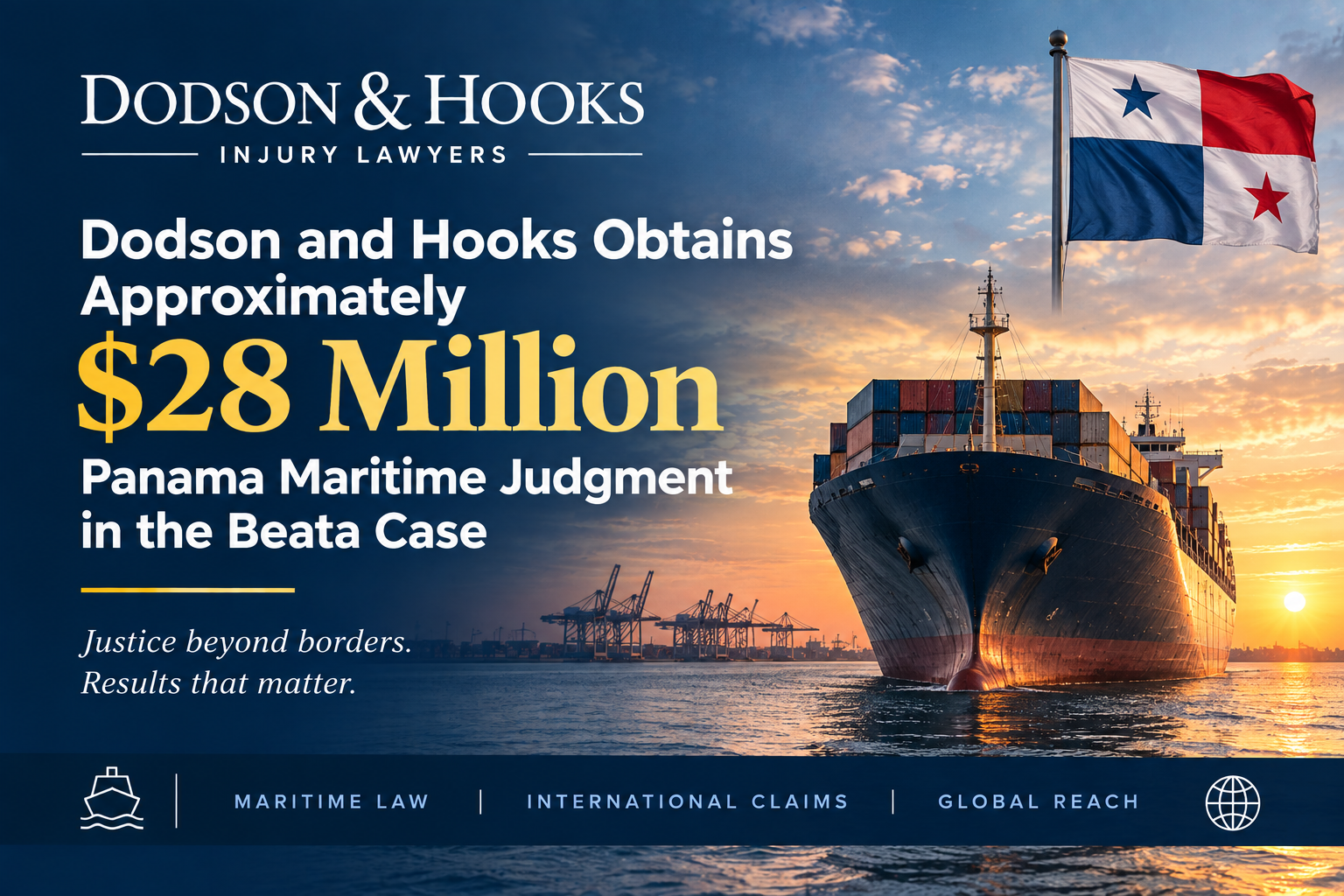
Dodson and Hooks Obtains Approximately 28 Million Dollar Panama Maritime Judgment in the Beata Case

Dodson & Hooks, along with Panamanian partner, Adrian Navarro, https://navarromaritime.com/#
A Panama maritime court has entered a judgment of approximately $28 million in the Beata case, a complex international maritime matter handled by Dodson & Hooks on behalf of the family of the vessel’s captain. The result follows years of work across borders, languages, legal systems, vessel records, insurance issues, and international enforcement questions.
The judgment arises from the December 20, 2022 fire aboard the Panama-flagged dry cargo vessel M/V BEATA off the Black Sea coast of Turkey. The captain was lost in the casualty. For his family, the case was never simply about a number. It was about accountability for a life lost at sea and the legal protections owed to seafarers and their families when a maritime disaster occurs far from home.
An approximately $28 million judgment is a major result, but every case is different and a judgment is not the same as money collected. Post-judgment proceedings and international enforcement efforts may continue. Dodson & Hooks is committed to pursuing every lawful avenue available to protect its clients and enforce the rights established by the court.
A Fatal Fire on the Panama Flagged M V Beata
The M/V BEATA was a Panama-flagged dry cargo vessel. Public casualty reports state that a fire broke out aboard the vessel on December 20, 2022, while it was off the coast of Sinop and Yakakent, Turkey. The crew faced an emergency at sea, and the vessel’s captain was reported missing and feared dead. The casualty triggered difficult questions concerning responsibility, maritime insurance, the rights of the captain’s family, and where legal relief could be pursued.
Cases involving a foreign casualty and a Panama-flagged vessel rarely fit inside a single legal system. The accident may occur in one country’s waters, the vessel may be registered in another country, the owner may be organized elsewhere, the crew may come from several nations, and the vessel’s protection and indemnity insurer may operate through companies and managers in still other jurisdictions. That is precisely why international seafarer claims demand more than ordinary personal-injury experience.
A lawyer handling an international maritime death case must identify the governing law, preserve evidence located in several countries, understand the vessel’s registration and management structure, examine contracts and insurance documents, and select a forum capable of granting meaningful relief. Even after a judgment is entered, assets and responsible entities may be located outside the country where the judgment was obtained.
Why Panama Was Central to the Case
Panama is one of the world’s leading ship registries. A vessel flying the Panama flag operates within a legal and regulatory framework that can be important when a crew member is injured or killed. Panama also has specialized maritime courts that address shipping disputes and claims connected to Panama-flagged vessels and maritime commerce.
The Beata litigation required attention not only to the vessel’s Panama registration, but also to the conduct and obligations of entities connected to the vessel and its insurance. The case illustrates a point that is often missed after a serious casualty: the physical location of the accident does not necessarily identify every available claim, every proper defendant, or every court with authority to hear the dispute.
For injured seafarers and grieving families, the first forum suggested by an employer, shipowner, crewing agency, or insurer may not be the only possible forum. Employment agreements, collective bargaining agreements, vessel records, flag-state law, insurance certificates, corporate relationships, and international conventions all may affect the legal analysis. Those documents should be examined carefully before rights are released or deadlines expire.
The Role of Protection and Indemnity Insurance
Ocean-going vessels commonly obtain protection and indemnity coverage, often called P&I insurance, for maritime liabilities that may include crew injury, illness, death, repatriation, collision, pollution, cargo, wreck removal, and other risks. In an international seafarer case, identifying the P&I insurer is only the beginning.
Counsel may need to determine which entity issued the coverage, which rules were incorporated into the policy, whether a certificate or financial-security document was provided to the flag state, whether a direct action is available, how notice was given, and where a judgment may be recognized and enforced. P&I organizations can have managers, correspondents, brokers, affiliates, and assets spread across several countries. Their rules may contain foreign-law, arbitration, jurisdiction, or “pay to be paid” provisions that require close analysis.
The Beata matter involved Maritime Mutual Insurance Association (NZ) Limited. Public regulatory materials identify Maritime Mutual as a New Zealand-incorporated entity that provided marine insurance outside New Zealand. The Reserve Bank of New Zealand stated that the company was not a licensed insurer under New Zealand’s Insurance Prudential Supervision Act and was not prudentially supervised there. Those regulatory facts require careful description: incorporation in New Zealand is not the same as being licensed or prudentially supervised as a New Zealand insurer.
Maritime Mutual’s relationship with Panama was also relevant. Panama maintained an approval system for P&I clubs and other providers issuing specified financial-security documents for Panama-flagged ships. These kinds of regulatory contacts, policy documents, certificates, and insurer communications can become important when courts evaluate jurisdiction, responsibility, and enforcement.
What the Approximately 28 Million Dollar Judgment Means
The Panama judgment represents judicial recognition of the claims presented in the Beata litigation and the magnitude of the loss suffered. No award can replace a husband, father, or family member lost at sea. A substantial maritime judgment can, however, provide financial security, acknowledge the seriousness of the loss, and impose legal accountability.
The result also demonstrates why international maritime cases should be investigated with a global strategy from the outset. The merits case and the enforcement case cannot always be separated. Counsel must consider service, jurisdiction, insurance, corporate structure, asset location, and recognition of foreign judgments while the underlying claim is being developed.
Dodson & Hooks approached the Beata case as an international maritime matter, not as a routine accident claim. The work required coordination with lawyers and professionals outside the United States, analysis of foreign legal materials, and sustained attention to the practical question that follows every judgment: where and how can the judgment be enforced?
International Judgment Enforcement May Continue After Trial
A judgment is a decisive legal achievement, but it may not end an international dispute. When a defendant or insurer is located in another country, the judgment creditor may need to ask a court in that country to recognize and enforce the foreign judgment. The enforcing court may examine whether the original court had jurisdiction, whether the defendant received proper notice, whether the proceeding was fair, and whether recognition would conflict with the enforcing country’s public policy.
Assets may also be subject to regulatory restrictions, sanctions, freezing orders, insolvency proceedings, or competing claims. These issues can affect the timing and method of recovery. For that reason, Dodson & Hooks does not equate obtaining a judgment with collecting it, and the firm does not promise that any judgment will be paid in full. The firm’s work continues where post-judgment proceedings are necessary.
That distinction matters to families choosing a maritime lawyer. A firm may have to pursue the claim beyond the casualty investigation and courtroom judgment. International enforcement can require foreign counsel, certified records and translations, asset investigation, and a detailed understanding of how one country treats judgments issued by another.
Why International Seafarer Claims Are Different
Seafarers work in one of the world’s most dangerous industries. They may spend months away from home, work long hours in heavy weather, and respond to fires, machinery failures, cargo emergencies, collisions, groundings, and abandon-ship events. When injury or death occurs, the legal system can appear almost as complicated as the casualty itself.
An international maritime lawyer may need to investigate several overlapping sources of rights and remedies, including:
- the law of the vessel’s flag state, including Panama maritime law;
- the law of the place where the casualty occurred;
- the seafarer employment agreement and any incorporated collective bargaining terms;
- general maritime law and any applicable national seafarer-protection statutes;
- the Maritime Labour Convention and flag-state financial-security requirements;
- P&I insurance rules, certificates, Blue Cards, and direct-action provisions;
- the citizenship and residence of the seafarer and surviving family members;
- the location, management, ownership, and operation of the vessel; and
- the countries where defendants, insurers, or assets may be found.
No single factor answers every jurisdictional or liability question. The documents and facts must be studied together. Acting quickly is also important because evidence can disappear, vessels can change ownership or location, companies can restructure, and contractual or statutory deadlines may be short.
A Louisiana Maritime Firm Handling Cases Around the World
Dodson & Hooks is based in Baton Rouge, Louisiana, but its maritime practice is international. The firm represents seafarers, offshore workers, vessel crewmembers, and families in cases involving foreign vessels, foreign employers, international insurers, and casualties occurring far from the United States.
Kenneth H. Hooks, III and the maritime lawyers at Dodson & Hooks understand that an international case requires persistence and coordination. The firm works with foreign lawyers, investigators, medical experts, marine-safety professionals, economists, and other specialists when a case requires their knowledge. It also evaluates possible claims against vessel owners, operators, employers, crewing agencies, contractors, manufacturers, and maritime insurers based on the evidence and governing law.
The Beata judgment reflects that commitment. The firm pursued a complex Panama maritime claim arising from a fatal shipboard fire and obtained a judgment of approximately $28 million. The result does not guarantee a similar outcome in another matter, but it shows the importance of selecting counsel prepared to confront cross-border legal and insurance issues rather than treating them as obstacles that cannot be overcome.
Questions Families Should Ask After a Death or Serious Injury at Sea
- What flag was the vessel flying at the time of the casualty?
- Who owned, operated, managed, and crewed the vessel?
- Where did the accident occur, and which authorities investigated it?
- What does the seafarer employment agreement say about governing law, jurisdiction, or arbitration?
- Which P&I club or maritime insurer covered the vessel, and what certificates were issued?
- Were the family’s death, disability, wages, repatriation, and contractual benefits paid?
- Are there potential claims in more than one country?
- Where are the responsible companies and collectible assets located?
- What deadlines apply, and has evidence been preserved?
Families should not assume that a payment offered immediately after a casualty represents the full value of their rights. They should also be cautious about signing releases, settlements, receipts, or powers of attorney before receiving independent legal advice. A document signed in one country may later be invoked in another.
Contact Dodson and Hooks About an International Maritime Claim
If you or a family member was injured while working aboard a Panama-flagged vessel, or if a loved one died in an international maritime casualty, Dodson & Hooks can evaluate the potential claims, available forums, maritime insurance, and enforcement issues. The firm handles serious maritime injury and wrongful-death matters involving cargo ships, tankers, offshore vessels, workboats, tugboats, barges, fishing vessels, and other commercial vessels.
Contact Dodson & Hooks at 225-235-3380 to request a confidential consultation. The firm’s office is located at 112 Founders Drive, Baton Rouge, Louisiana 70810. You may also contact the firm through DodsonHooks.com.