112 Founders Drive Baton Rouge, LA 70810 | 225-756-0222
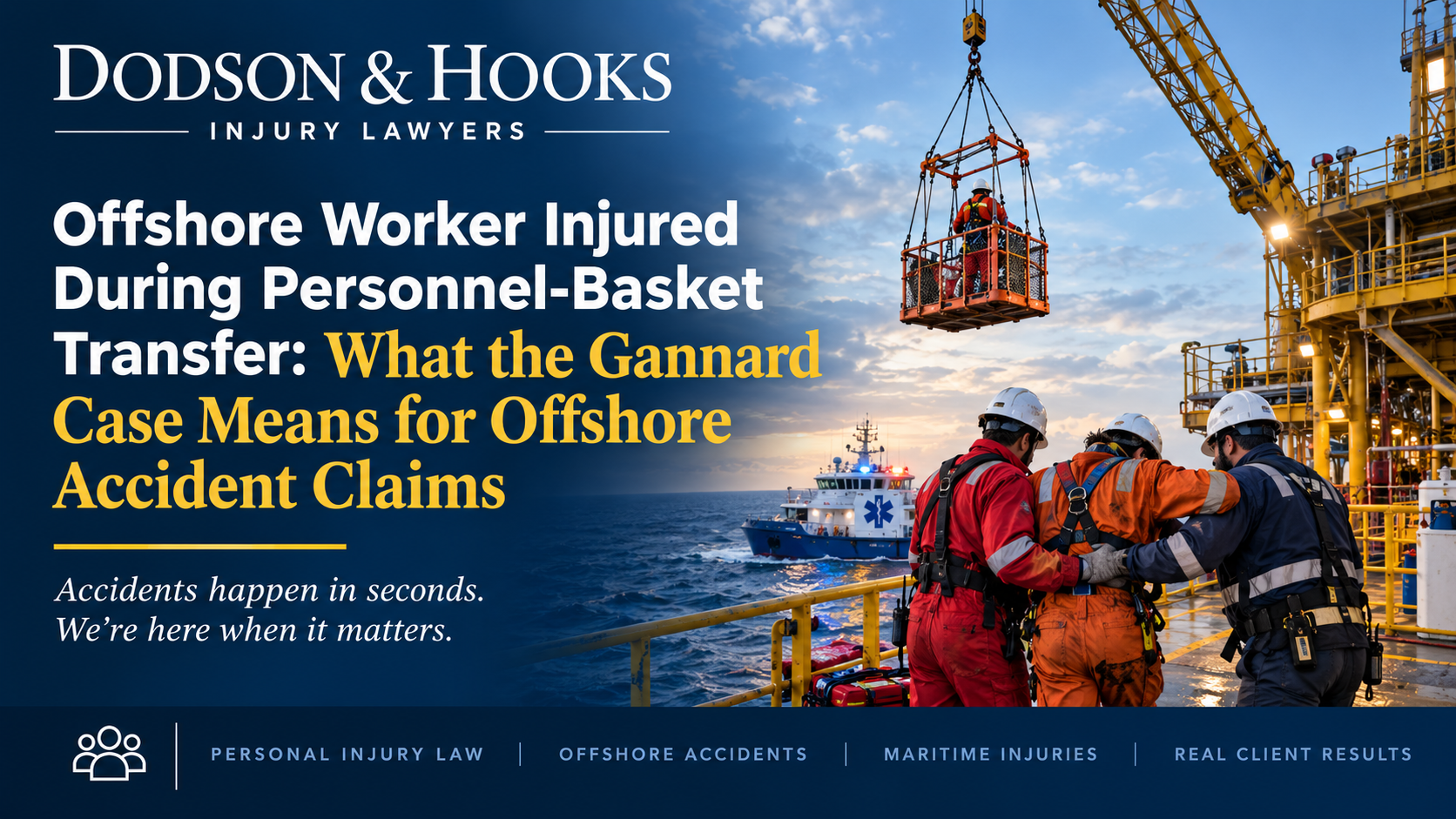
Offshore Worker Injured During Personnel-Basket Transfer: What the Gannard Case Means for Offshore Accident Claims

Transferring workers between vessels and offshore platforms is a routine part of offshore oil and gas operations. It can also be one of the most dangerous parts of an offshore worker’s job.
A recent federal case from Louisiana illustrates how an injury during a personnel-basket transfer can raise claims against multiple companies involved in vessel and platform operations.
In Gannard v. Island Operating Co., an offshore worker alleged that he was injured while being transferred by personnel basket from the M/V GOL FORCE to a fixed offshore platform at Main Pass 123.
According to the allegations discussed by the court, the personnel basket was being lifted from the vessel when conditions involving the vessel, crane operation, slack in the lifting line, and wave movement allegedly caused the worker to be slammed onto the vessel’s deck.
The defendants sought summary judgment. The court concluded that factual disputes prevented disposition of significant portions of the negligence claims without a trial.
Why Personnel-Basket Injuries Can Be Legally Complicated
An offshore personnel transfer may involve several different companies.
Depending upon the operation, those can include:
- the injured worker’s employer;
- the vessel owner or operator;
- the platform owner;
- an offshore operating company;
- the crane owner or operator; and
- independent contractors responsible for particular portions of the operation.
Determining which company controlled the operation—and which company’s conduct contributed to the accident—can therefore be critical.
An injured offshore worker should not assume that workers’ compensation is necessarily the only potential source of recovery.
Vessel Movement Can Be Important
Personnel-basket transfers require coordination between the vessel and the crane.
A vessel moving with waves can rise or fall while a worker is suspended or while the basket is being lifted. Slack in the line, vessel positioning, crane operation and communication among the workers involved in the transfer can all become important evidence.
That means an investigation should consider much more than simply asking who operated the crane.
Potential evidence can include vessel logs, weather and sea conditions, crane records, safety procedures, training records, witness statements, photographs or video, maintenance records, and communications between vessel and platform personnel.
Which Law Applies to an Offshore Platform Accident?
Offshore injury cases frequently involve overlapping bodies of law.
Depending upon where the accident occurred and the worker’s employment status, potential sources of law may include the Outer Continental Shelf Lands Act (OCSLA), the Longshore and Harbor Workers’ Compensation Act (LHWCA), general maritime law, the Jones Act, and state law adopted as surrogate federal law.
The legal classification of the structure is also important. A fixed offshore platform is generally treated differently from a vessel.
The Gannard litigation demonstrates why the precise facts surrounding an offshore accident matter when determining which law applies and which defendants may potentially be responsible.
Section 905(b) Claims Against Vessels
Some offshore workers covered by the LHWCA may have negligence claims against a vessel under 33 U.S.C. § 905(b).
These claims are distinct from the worker’s compensation claim against his or her employer.
Whether a Section 905(b) claim exists depends upon the worker’s status, the identity of the vessel owner, the relationship among the companies involved, and the conduct that allegedly caused the injury.
Why Early Investigation Matters
Offshore accidents can generate important evidence that may disappear quickly.
Vessels move. Crews change. Video may be overwritten. Equipment may be repaired or returned to service. Contractors may leave the project.
For a serious personnel-transfer accident, an attorney may need to determine quickly:
- Who owned and operated the vessel?
- Who controlled the crane?
- Who supervised the transfer?
- What procedures governed personnel transfers?
- What were the weather, wave and vessel conditions?
- Were there photographs or video recordings?
- Did the vessel or platform prepare an incident report?
- Were similar incidents or problems previously reported?
Those questions can affect both liability and which companies should be included in a claim.
Louisiana Lawyers Handling Offshore Injury Cases
Dodson & Hooks represents injured maritime and offshore workers and works with referring attorneys in cases involving vessels, offshore platforms and maritime operations.
Offshore accidents can involve a combination of federal maritime law, OCSLA, the LHWCA and Louisiana law. Determining the applicable law early can be just as important as determining how the accident occurred.
Case discussed: Gannard v. Island Operating Co., No. 6:23-cv-993 (W.D. La. 2026).
This article discusses a reported judicial decision for informational purposes. Every offshore accident depends upon its particular facts, employment relationships and location.