112 Founders Drive Baton Rouge, LA 70810 | 225-756-0222
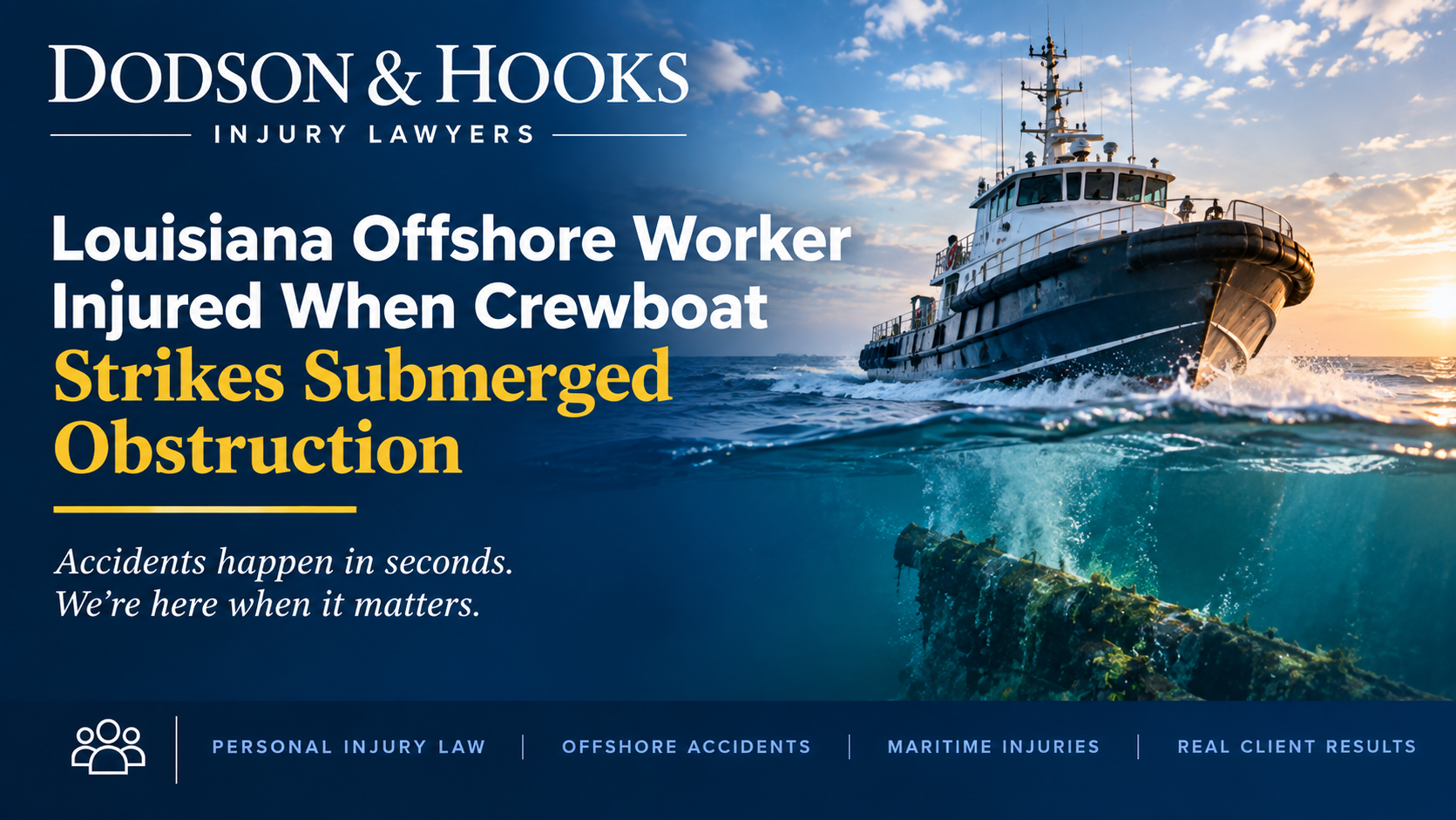
Louisiana Offshore Worker Injured When Crewboat Strikes Submerged Obstruction

Crewboats transport thousands of workers between Louisiana ports and offshore oil and gas facilities. When a crewboat collides with an object, runs aground or is involved in another navigation accident, the resulting injury case can involve considerably more than a simple negligence claim.
In re Texas Petroleum Investment Co. provides a recent Louisiana example.
Texas Petroleum Investment owned the South Pass Block 24 platform and the crewboat LA 9395, which transported workers between the offshore facility and the dock in Venice, Louisiana.
The vessel was carrying workers when it struck a submerged obstruction in inland waters in Plaquemines Parish. George Walcott, a worker employed by Taylors International Services, was injured.
The resulting litigation in the Eastern District of Louisiana raised several issues that frequently arise after offshore and crewboat accidents.
A Vessel Owner May File a Limitation of Liability Action
After a serious marine casualty, an injured person may expect to be the party filing a lawsuit.
Maritime law, however, gives a vessel owner another option.
Under the federal Limitation of Liability Act, a vessel owner may file an action asking a federal court to limit its liability under circumstances permitted by the statute.
Texas Petroleum Investment filed such an action following the LA 9395 accident.
A limitation proceeding can affect where and how an injured worker pursues his claims. It can also impose deadlines for filing claims.
For an injured worker—or an attorney unfamiliar with admiralty practice—receiving notice of a limitation action should therefore be taken seriously.
Why Other Companies’ Claims Can Matter
Walcott sought to lift the federal limitation stay so he could pursue his claim elsewhere.
But other companies involved in the litigation had asserted indemnity and contribution claims.
The Louisiana federal court explained that parties seeking contribution or indemnification from a vessel owner can themselves qualify as claimants under the Limitation Act. Because all claimants had not entered the necessary stipulations protecting the vessel owner’s limitation rights, the court declined to lift the stay.
This is an important feature of maritime litigation: contractual disputes among companies can directly affect how an injured worker’s case proceeds.
Borrowed-Servant Status in Offshore Injury Cases
The case also addressed the borrowed-servant doctrine.
Offshore workers frequently receive their paycheck from one company while taking their day-to-day instructions from another.
That arrangement can have major legal consequences.
The court analyzed whether workers involved in the operation were borrowed servants by considering factors including who controlled the work, whose work was being performed, who supplied the tools, the length of the relationship, who could remove the worker from the assignment and how payment was handled.
The court concluded that the production operator involved in the case was a borrowed servant of Texas Petroleum Investment. It found factual issues concerning whether Walcott, who worked as a cook on the platform, had the same status.
The distinction demonstrates why the name on a worker’s paycheck does not necessarily answer the question of who is considered his employer under maritime or offshore law.
Negligent Navigation and Crewboat Accidents
The underlying accident involved a crewboat striking a submerged obstruction.
Depending upon the evidence, a crewboat accident investigation may examine:
- vessel speed;
- navigation route;
- charts and electronic navigation equipment;
- captain training and experience;
- lookout procedures;
- visibility;
- water depth;
- known underwater hazards;
- Coast Guard reports;
- voyage and engine data;
- company navigation policies; and
- previous incidents.
When an offshore worker is injured as a passenger, counsel should investigate the vessel operation independently rather than assume the incident was simply an unavoidable marine casualty.
Offshore Contracts Can Affect the Litigation
The case also involved contractual defense and indemnity provisions and the Louisiana Oilfield Indemnity Act.
Those issues ordinarily concern allocation of liability among the companies rather than the injured worker’s physical damages. But they can become important when determining which companies ultimately bear financial responsibility for an offshore accident.
That is one reason serious offshore cases frequently require analysis of the contracts among vessel owners, operators, staffing companies and oilfield contractors.
Offshore Injuries Near Venice and Plaquemines Parish
Venice, Port Fourchon and other South Louisiana ports serve as gateways to offshore operations throughout the Gulf.
Accidents involving crewboats and offshore workers may implicate the Jones Act, general maritime law, the Longshore and Harbor Workers’ Compensation Act, the Outer Continental Shelf Lands Act, the Limitation of Liability Act and Louisiana law.
The applicable law depends on facts including the worker’s job, the type of structure involved, where the accident occurred and the relationships among the companies.
Louisiana Offshore and Maritime Injury Lawyers
Dodson & Hooks represents injured maritime and offshore workers and works with attorneys who need experienced maritime co-counsel in Louisiana.
When a serious crewboat or offshore accident occurs, early investigation can help identify the responsible companies, preserve vessel evidence and determine which maritime statutes apply.
Case discussed: In re Texas Petroleum Investment Co., No. 2:24-cv-2344 (E.D. La. 2026).
This article discusses a reported Louisiana federal case for informational purposes. Maritime and offshore claims are highly fact-specific, and different legal rules may apply depending upon the worker, vessel, location and employment relationships.